corsika::sibyll::Interaction Class Reference
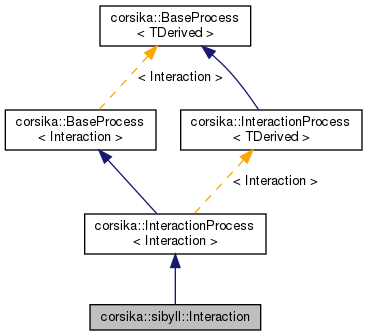
Inheritance diagram for corsika::sibyll::Interaction:
Public Member Functions | |
| Interaction (bool const sibyll_printout_on=false) | |
| bool | isValidCoMEnergy (HEPEnergyType const ecm) const |
| bool | isValidTarget (Code const TargetId) const |
| sibyll only accepts nuclei with 4<=A<=18 as targets, or protons aka Hydrogen or neutrons (p,n == nucleon) | |
| std::tuple< CrossSectionType, CrossSectionType > | getCrossSection (Code const, Code const, HEPEnergyType const) const |
| returns production and elastic cross section for hadrons in sibyll. Inputs are: CorsikaId of beam particle, CorsikaId of target particle and center-of-mass energy. Allowed targets are: nuclei or single nucleons (p,n,hydrogen). | |
| template<typename TParticle > | |
| GrammageType | getInteractionLength (TParticle const &) const |
| template<typename TSecondaries > | |
| void | doInteraction (TSecondaries &) |
| In this function SIBYLL is called to produce one event. More... | |
 Public Member Functions inherited from corsika::InteractionProcess< Interaction > Public Member Functions inherited from corsika::InteractionProcess< Interaction > | |
| InverseGrammageType | getInverseInteractionLength (TParticle const &particle) |
Additional Inherited Members | |
| Public Types inherited from corsika::BaseProcess< Interaction > | |
| using | process_type = Interaction |
| Base processor type for use in other template classes. | |
| Static Public Attributes inherited from corsika::BaseProcess< Interaction > | |
| static bool const | is_process_sequence |
| static bool const | is_switch_process_sequence |
| Protected Member Functions inherited from corsika::BaseProcess< Interaction > | |
| Interaction & | ref () |
| const Interaction & | ref () const |
| Protected Attributes inherited from corsika::BaseProcess< Interaction > | |
| friend | TDerived |
Detailed Description
Definition at line 19 of file Interaction.hpp.
Member Function Documentation
◆ doInteraction()
template<typename TSecondaries >
| void corsika::sibyll::Interaction::doInteraction | ( | TSecondaries & | ) |
In this function SIBYLL is called to produce one event.
The event is copied (and boosted) into the shower lab frame.
The documentation for this class was generated from the following file:
- corsika/modules/sibyll/Interaction.hpp