Stack.hpp File Reference
Description of particle stacks. More...
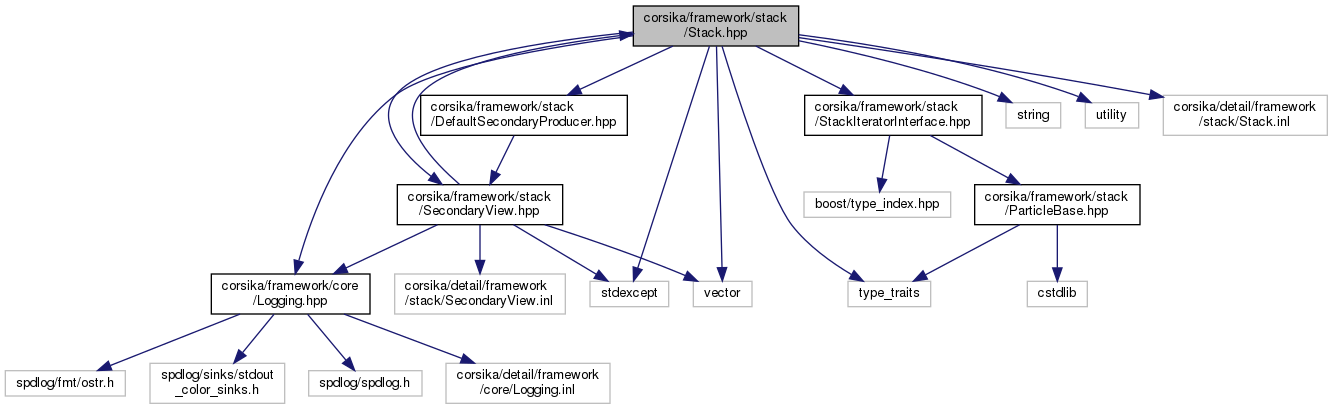
#include <corsika/framework/core/Logging.hpp>#include <corsika/framework/stack/StackIteratorInterface.hpp>#include <corsika/framework/stack/DefaultSecondaryProducer.hpp>#include <corsika/framework/stack/SecondaryView.hpp>#include <stdexcept>#include <string>#include <vector>#include <utility>#include <type_traits>#include <corsika/detail/framework/stack/Stack.inl>
Include dependency graph for Stack.hpp:
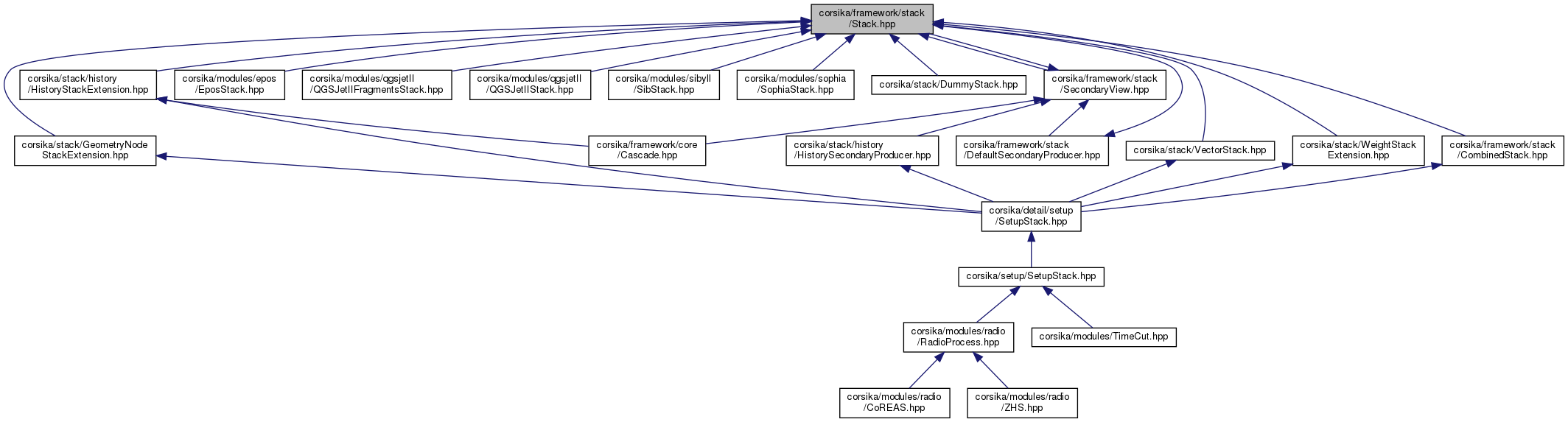
This graph shows which files directly or indirectly include this file:
Go to the source code of this file.
Classes | |
| class | corsika::Stack< TStackData, MParticleInterface, MSecondaryProducer > |
| The Stack class provides (and connects) the main particle data storage machinery. More... | |
Namespaces | |
| corsika | |
| `, since they are used everywhere as integral part of the framework. | |
Detailed Description
Description of particle stacks.
In the CORSIKA 8 framework particle data is always stored in particle stacks. A particle is, thus, always a reference (iterator) to an entry on a stack, e.g.
  ModelStack stack;
  stack.begin(); // returns an iterator: StackIterator, ConstStackIterator

  *stack.begin(); // return a reference to ParticleInterfaceType, which is the class
provided by the user to read/write particle properties
All functionality and algorithms for stack data access is located in the namespace corsika::stack
The minimal example of how to use this is shown in stack_example.cc
Definition in file Stack.hpp.