Processes with continuous effects along a particle Trajectory. More...
#include <ContinuousProcess.hpp>
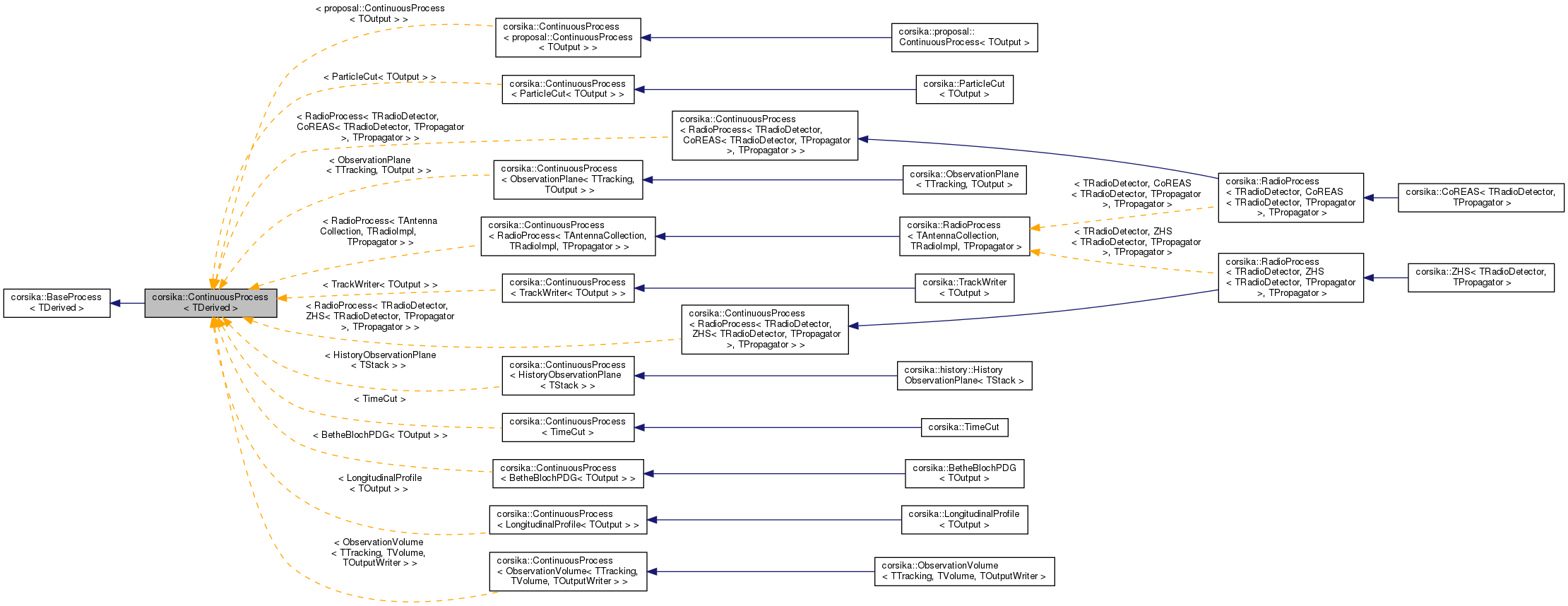
Additional Inherited Members | |
 Public Types inherited from corsika::BaseProcess< TDerived > Public Types inherited from corsika::BaseProcess< TDerived > | |
| using | process_type = TDerived |
| Base processor type for use in other template classes. | |
| Static Public Attributes inherited from corsika::BaseProcess< TDerived > | |
| static bool const | is_process_sequence = false |
| static bool const | is_switch_process_sequence = false |
| Protected Member Functions inherited from corsika::BaseProcess< TDerived > | |
| TDerived & | getRef () |
| const TDerived & | getRef () const |
| Protected Attributes inherited from corsika::BaseProcess< TDerived > | |
| friend | TDerived |
Detailed Description
template<typename TDerived>
class corsika::ContinuousProcess< TDerived >
Processes with continuous effects along a particle Trajectory.
Create a new ContinuousProcess, e.g. for XYModel, via:
and provide two necessary interface methods:
which allows any ContinuousProcess to tell to CORSIKA a maximum allowed step length. Such step-length limitation, if it turns out to be smaller/sooner than any other limit (decay length, interaction length, other continuous processes, geometry, etc.) will lead to a limited step length.
which applied any continuous effects on Particle p along Trajectory t. The particle in all typical scenarios will be altered by a doContinuous. The flag stepLimit will be true if the preious evaluation of getMaxStepLength resulted in this particular ContinuousProcess to be responsible for the step length limit on the current track t. This information can be expoited and avoid e.g. any uncessary calculations.
Particle and Track are the valid classes to access particles and track (Trajectory) data on the Stack. Those two methods do not need to be templated, they could use the types e.g. corsika::setup::Stack::particle_type – but by the cost of loosing all flexibility otherwise provided.
Definition at line 65 of file ContinuousProcess.hpp.
The documentation for this class was generated from the following file:
- corsika/framework/process/ContinuousProcess.hpp