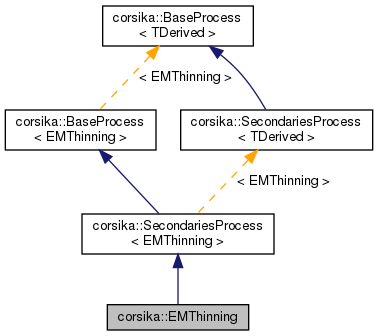
This process implements thinning for EM splitting processes (1 -> 2). More...
#include <EMThinning.hpp>
Public Member Functions | |
| EMThinning (HEPEnergyType threshold, double maxWeight, bool const eraseParticles=true) | |
| Construct a new EMThinning process. More... | |
| template<typename TStackView > | |
| void | doSecondaries (TStackView &) |
| Apply thinning to secondaries. More... | |
Additional Inherited Members | |
 Public Types inherited from corsika::BaseProcess< EMThinning > Public Types inherited from corsika::BaseProcess< EMThinning > | |
| using | process_type = EMThinning |
| Base processor type for use in other template classes. | |
| Static Public Attributes inherited from corsika::BaseProcess< EMThinning > | |
| static bool const | is_process_sequence |
| static bool const | is_switch_process_sequence |
| Protected Member Functions inherited from corsika::BaseProcess< EMThinning > | |
| EMThinning & | getRef () |
| const EMThinning & | getRef () const |
| Protected Attributes inherited from corsika::BaseProcess< EMThinning > | |
| friend | TDerived |
Detailed Description
This process implements thinning for EM splitting processes (1 -> 2).
Definition at line 23 of file EMThinning.hpp.
Constructor & Destructor Documentation
◆ EMThinning()
| corsika::EMThinning::EMThinning | ( | HEPEnergyType | threshold, |
| double | maxWeight, | ||
| bool const | eraseParticles = true |
||
| ) |
Construct a new EMThinning process.
- Parameters
-
threshold thinning applied below this energy maxWeight maximum allowed weight
Member Function Documentation
◆ doSecondaries()
| void corsika::EMThinning::doSecondaries | ( | TStackView & | ) |
Apply thinning to secondaries.
Only EM primaries with two EM secondaries are considered.
If the maximum weight is still out of reach, Hillas thinning is applied (i.e. one of the two secondaries is kept, the other one discarded). If the acceptance probabilities would lead to a weight factor exceeding the maximum weight, we resort to statistical thinning (i.e. the secondaries are kept/discared randomly each on is own). In that case, acceptance probabilities can be assigned without constraints (sum does not need to be 1) and we increase the acceptance probability such that the maximum weight is not exceeded.
The documentation for this class was generated from the following file:
- corsika/modules/thinning/EMThinning.hpp