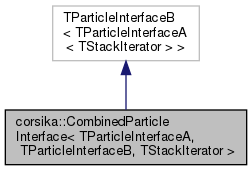
CombinedParticleInterface can be used to combine the data of several StackData objects. More...
#include <CombinedStack.hpp>
Public Types | |
| typedef CombinedParticleInterface< TParticleInterfaceA, TParticleInterfaceB, TStackIterator > | pi_c_type |
| typedef TParticleInterfaceA< TStackIterator > | pi_a_type |
| typedef TParticleInterfaceB< TParticleInterfaceA< TStackIterator > > | pi_b_type |
Public Member Functions | |
| std::string | asString () const |
wrapper for user functions | |
In this set of functions we call the user-provide TParticleInterface setParticleData(...) methods, either with parent particle reference, or w/o. There is one implicit assumption here: if only one data tuple is provided for setParticleData, the data is passed on to TParticleInterfaceA and the TParticleInterfaceB is default-initialized. There are many occasions where this is the desired behaviour, e.g. for thinning etc. | |
| template<typename... TArgs1> | |
| void | setParticleData (std::tuple< TArgs1... > const vA) |
| template<typename... TArgs1, typename... TArgs2> | |
| void | setParticleData (std::tuple< TArgs1... > const vA, std::tuple< TArgs2... > const vB) |
| template<typename... TArgs1> | |
| void | setParticleData (pi_a_type &p, std::tuple< TArgs1... > const vA) |
| template<typename... TArgs1, typename... TArgs2> | |
| void | setParticleData (pi_c_type &p, std::tuple< TArgs1... > const vA, std::tuple< TArgs2... > const vB) |
Detailed Description
template<template< typename > typename TParticleInterfaceA, template< typename > class TParticleInterfaceB, typename TStackIterator>
struct corsika::CombinedParticleInterface< TParticleInterfaceA, TParticleInterfaceB, TStackIterator >
CombinedParticleInterface can be used to combine the data of several StackData objects.
You may combine two StackData object, see class CombinedStackImpl below, into one Stack, using a combined StackIterator (aka CombinedParticleInterface) interface class.
This allows to add specific information to a given Stack, could be special information on a subset of entries (e.g. NuclearStackExtension) or also (multi) thinning weights for all particles.
Many Stacks can be combined into more complex object.
The two sub-stacks must both provide their independent ParticleInterface classes.
Definition at line 39 of file CombinedStack.hpp.
The documentation for this struct was generated from the following file:
- corsika/framework/stack/CombinedStack.hpp