A common abstract interface for radio antennas. More...
#include <Antenna.hpp>
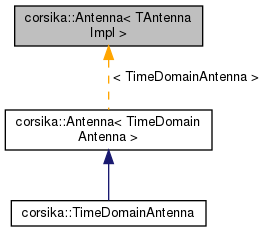
Public Types | |
| using | axistype = std::vector< long double > |
Public Member Functions | |
| Antenna (std::string const &name, Point const &location, CoordinateSystemPtr const &coordinateSystem) | |
| Construct a base antenna instance. More... | |
| template<typename... TVArgs> | |
| void | receive (TVArgs &&... args) |
| Receive a signal at this antenna. More... | |
| Point const & | getLocation () const |
| Get the location of this antenna. | |
| std::string const & | getName () const |
| Get the name of this name antenna. More... | |
| void | reset () |
| Reset the antenna before starting a new simulation. | |
| axistype | getAxis () const |
| Return a reference to the x-axis labels (i.e. More... | |
| std::vector< double > const & | getWaveformX () const |
| Return a reference to the underlying waveform data for X polarization. More... | |
| std::vector< double > const & | getWaveformY () const |
| Return a reference to the underlying waveform data for Y polarization. More... | |
| std::vector< double > const & | getWaveformZ () const |
| Return a reference to the underlying waveform data for Z polarization. More... | |
| TAntennaImpl & | implementation () |
| Get a reference to the underlying radio implementation. | |
Protected Attributes | |
| std::string const | name_ |
| The name/identifier of this antenna. | |
| Point const | location_ |
| The location of this antenna. | |
| CoordinateSystemPtr const | coordinateSystem_ |
| The coordinate system of the antenna. | |
Detailed Description
template<typename TAntennaImpl>
class corsika::Antenna< TAntennaImpl >
A common abstract interface for radio antennas.
All concrete antenna implementations should be of type Antenna<T> where T is a concrete antenna implementation.
Definition at line 25 of file Antenna.hpp.
Constructor & Destructor Documentation
◆ Antenna()
| corsika::Antenna< TAntennaImpl >::Antenna | ( | std::string const & | name, |
| Point const & | location, | ||
| CoordinateSystemPtr const & | coordinateSystem | ||
| ) |
Construct a base antenna instance.
- Parameters
-
name A name for this antenna. location The location of this antenna.
Member Function Documentation
◆ getAxis()
| axistype corsika::Antenna< TAntennaImpl >::getAxis | ( | ) | const |
Return a reference to the x-axis labels (i.e.
time or frequency).
This should be an xtensor-convertible type with a ->data() method that converts to a raw pointer.
◆ getName()
| std::string const& corsika::Antenna< TAntennaImpl >::getName | ( | ) | const |
Get the name of this name antenna.
This is used in producing the output data file.
◆ getWaveformX()
| std::vector<double> const& corsika::Antenna< TAntennaImpl >::getWaveformX | ( | ) | const |
Return a reference to the underlying waveform data for X polarization.
This is used when writing the antenna information to disk and will be converted to a 32-bit float before writing.
◆ getWaveformY()
| std::vector<double> const& corsika::Antenna< TAntennaImpl >::getWaveformY | ( | ) | const |
Return a reference to the underlying waveform data for Y polarization.
This is used when writing the antenna information to disk and will be converted to a 32-bit float before writing.
◆ getWaveformZ()
| std::vector<double> const& corsika::Antenna< TAntennaImpl >::getWaveformZ | ( | ) | const |
Return a reference to the underlying waveform data for Z polarization.
This is used when writing the antenna information to disk and will be converted to a 32-bit float before writing.
◆ receive()
| void corsika::Antenna< TAntennaImpl >::receive | ( | TVArgs &&... | args | ) |
Receive a signal at this antenna.
This is a general implementation call that must be specialized for the particular antenna implementation and usage.
The documentation for this class was generated from the following file:
- corsika/modules/radio/antennas/Antenna.hpp