corsika::Point Class Reference
#include <Point.hpp>
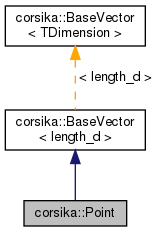
Inheritance diagram for corsika::Point:
Public Member Functions | |
| Point (CoordinateSystemPtr const &pCS, QuantityVector< length_d > const &pQVector) | |
| Point (CoordinateSystemPtr const &cs, LengthType x, LengthType y, LengthType z) | |
| QuantityVector< length_d > const & | getCoordinates () const |
| QuantityVector< length_d > & | getCoordinates () |
| QuantityVector< length_d > | getCoordinates (CoordinateSystemPtr const &pCS) const |
| this always returns a QuantityVector as triple More... | |
| QuantityVector< length_d > & | getCoordinates (CoordinateSystemPtr const &pCS) |
| this always returns a QuantityVector as triple More... | |
| void | rebase (CoordinateSystemPtr const &pCS) |
| Point | operator+ (Vector< length_d > const &pVec) const |
| Point | operator- (Vector< length_d > const &pVec) const |
| Vector< length_d > | operator- (Point const &pB) const |
access coordinate components | |
Note, if you access components in a different CoordinateSystem pCS than the stored data, internally a temporary object will be created and destroyed each call. This can be avoided by using rebase first. | |
| LengthType | getX (CoordinateSystemPtr const &pCS) const |
| LengthType | getY (CoordinateSystemPtr const &pCS) const |
| LengthType | getZ (CoordinateSystemPtr const &pCS) const |
 Public Member Functions inherited from corsika::BaseVector< length_d > Public Member Functions inherited from corsika::BaseVector< length_d > | |
| BaseVector (CoordinateSystemPtr const &pCS, QuantityVector< length_d > const &pQVector) | |
| BaseVector (BaseVector const &)=default | |
| BaseVector (BaseVector &&a)=default | |
| BaseVector & | operator= (BaseVector const &)=default |
| CoordinateSystemPtr | getCoordinateSystem () const |
| void | setCoordinateSystem (CoordinateSystemPtr const &cs) |
Additional Inherited Members | |
| Protected Member Functions inherited from corsika::BaseVector< length_d > | |
| QuantityVector< length_d > const & | getQuantityVector () const |
| QuantityVector< length_d > & | getQuantityVector () |
| void | setQuantityVector (QuantityVector< length_d > const &v) |
Detailed Description
A Point represents a point in position space. It is defined by its coordinates with respect to some CoordinateSystem.
Member Function Documentation
◆ getCoordinates() [1/3]
|
inline |
- Todo:
- TODO: this should be private or protected, we don NOT want to expose numbers without reference to outside:
◆ getCoordinates() [2/3]
|
inline |
this always returns a QuantityVector as triple
- Returns
- A value type QuantityVector, since it may have to create a temporary object to transform to pCS.
◆ getCoordinates() [3/3]
|
inline |
this always returns a QuantityVector as triple
- Returns
- A reference type QuantityVector&, but be aware, the underlying class data is actually transformed to pCS, if needed. Thus, there may be an implicit call to rebase.
◆ operator-()
returns the distance Vector between two points
◆ rebase()
|
inline |
transforms the Point into another CoordinateSystem by changing its coordinates interally
The documentation for this class was generated from the following file:
- corsika/framework/geometry/Point.hpp