Definition of a static process list/sequence. More...
#include <ProcessSequence.hpp>
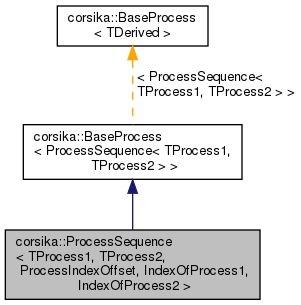
Public Member Functions | |
| ProcessSequence (ProcessSequence const &)=default | |
| ProcessSequence (ProcessSequence &&)=default | |
| ProcessSequence & | operator= (ProcessSequence const &)=default |
| ProcessSequence (TProcess1 in_A, TProcess2 in_B) | |
| Only valid user constructor will create fully initialized object. More... | |
| template<typename TParticle > | |
| ProcessReturn | doBoundaryCrossing (TParticle &particle, typename TParticle::node_type const &from, typename TParticle::node_type const &to) |
| List of all BoundaryProcess. More... | |
| template<typename TParticle > | |
| ProcessReturn | doContinuous (Step< TParticle > &step, ContinuousProcessIndex const limitID) |
| template<typename TSecondaries > | |
| void | doSecondaries (TSecondaries &vS) |
| Process all secondaries in TSecondaries. More... | |
| bool | checkStep () |
| The processes of type StackProcess do have an internal counter, so they can be exectuted only each N steps. More... | |
| template<typename TStack > | |
| void | doStack (TStack &stack) |
| Execute the StackProcess-es in the ProcessSequence. | |
| template<typename TStack > | |
| void | doCascadeEquations (TStack &stack) |
| Execute the CascadeEquationsProcess-es in the ProcessSequence. | |
| void | initCascadeEquations () |
| Init the CascadeEquationsProcess-es in the ProcessSequence. | |
| template<typename TParticle , typename TTrack > | |
| ContinuousProcessStepLength | getMaxStepLength (TParticle &&particle, TTrack &&vTrack) |
| Calculate the maximum allowed length of the next tracking step, based on all ContinuousProcess-es. More... | |
| template<typename TParticle > | |
| CrossSectionType | getCrossSection (TParticle const &projectile, Code const targetId, FourMomentum const &targetP4) const |
| Calculates the cross section of a projectile with a target. More... | |
| template<typename TParticle > | |
| TimeType | getLifetime (TParticle &particle) |
| template<typename TSecondaryView , typename TRNG > | |
| ProcessReturn | selectInteraction (TSecondaryView &&view, FourMomentum const &projectileP4, NuclearComposition const &composition, TRNG &&rng, CrossSectionType const cx_select, CrossSectionType cx_sum=CrossSectionType::zero()) |
| Selects one concrete InteractionProcess and samples a target nucleus from the material. More... | |
| template<typename TParticle > | |
| InverseTimeType | getInverseLifetime (TParticle &&particle) |
| template<typename TSecondaryView > | |
| ProcessReturn | selectDecay (TSecondaryView &&view, InverseTimeType decay_inv_select, InverseTimeType decay_inv_sum=InverseTimeType::zero()) |
Static Public Attributes | |
| static bool const | is_process_sequence = true |
 Static Public Attributes inherited from corsika::BaseProcess< ProcessSequence< TProcess1, TProcess2 > > Static Public Attributes inherited from corsika::BaseProcess< ProcessSequence< TProcess1, TProcess2 > > | |
| static bool const | is_process_sequence |
| static bool const | is_switch_process_sequence |
Additional Inherited Members | |
| Public Types inherited from corsika::BaseProcess< ProcessSequence< TProcess1, TProcess2 > > | |
| using | process_type = ProcessSequence< TProcess1, TProcess2 > |
| Base processor type for use in other template classes. | |
| Protected Member Functions inherited from corsika::BaseProcess< ProcessSequence< TProcess1, TProcess2 > > | |
| ProcessSequence< TProcess1, TProcess2 > & | getRef () |
| const ProcessSequence< TProcess1, TProcess2 > & | getRef () const |
| Protected Attributes inherited from corsika::BaseProcess< ProcessSequence< TProcess1, TProcess2 > > | |
| friend | TDerived |
Detailed Description
template<typename TProcess1, typename TProcess2 = NullModel, int ProcessIndexOffset = 0, int IndexOfProcess1 = corsika::count_processes< TProcess1, corsika::count_processes<TProcess2, ProcessIndexOffset>::count>::count, int IndexOfProcess2 = corsika::count_processes<TProcess2, ProcessIndexOffset>::count>
class corsika::ProcessSequence< TProcess1, TProcess2, ProcessIndexOffset, IndexOfProcess1, IndexOfProcess2 >
Definition of a static process list/sequence.
A compile time static list of processes. The compiler will generate a new type based on template logic containing all the elements provided by the user.
TProcess1 and TProcess2 must both be derived from BaseProcess, and are both references if possible (lvalue), otherwise (rvalue) they are just classes. This allows us to handle both, rvalue as well as lvalue Processes in the ProcessSequence.
(For your potential interest, the static version of the ProcessSequence and all Process types are based on the CRTP C++ design pattern).
Template parameters:
- Template Parameters
-
TProcess1 is of type BaseProcess, either a dedicatd process, or a ProcessSequence TProcess2 is of type BaseProcess, either a dedicatd process, or a ProcessSequence IndexFirstProcess to count and index each Process in the entire process-chain. The offset is the starting value for this ProcessSequence IndexOfProcess1 index of TProcess1 (counting of Process) IndexOfProcess2 index of TProcess2 (counting of Process)
Definition at line 163 of file ProcessSequence.hpp.
Constructor & Destructor Documentation
◆ ProcessSequence()
| corsika::ProcessSequence< TProcess1, TProcess2, ProcessIndexOffset, IndexOfProcess1, IndexOfProcess2 >::ProcessSequence | ( | TProcess1 | in_A, |
| TProcess2 | in_B | ||
| ) |
Only valid user constructor will create fully initialized object.
ProcessSequence supports and encourages move semantics. You can use object, l-value references or r-value references to construct sequences.
- Parameters
-
in_A BaseProcess or switch/process list in_B BaseProcess or switch/process list
Member Function Documentation
◆ checkStep()
| bool corsika::ProcessSequence< TProcess1, TProcess2, ProcessIndexOffset, IndexOfProcess1, IndexOfProcess2 >::checkStep | ( | ) |
The processes of type StackProcess do have an internal counter, so they can be exectuted only each N steps.
Often these are "maintenacne processes" that do not need to run after each single step of the simulations. In the CheckStep function it is tested if either A_ or B_ are StackProcess and if they are due for execution.
◆ doBoundaryCrossing()
| ProcessReturn corsika::ProcessSequence< TProcess1, TProcess2, ProcessIndexOffset, IndexOfProcess1, IndexOfProcess2 >::doBoundaryCrossing | ( | TParticle & | particle, |
| typename TParticle::node_type const & | from, | ||
| typename TParticle::node_type const & | to | ||
| ) |
List of all BoundaryProcess.
- Template Parameters
-
TParticle
- Parameters
-
particle The particle. from Volume the particle is exiting. to Volume the particle is entering.
- Returns
- ProcessReturn
◆ doSecondaries()
| void corsika::ProcessSequence< TProcess1, TProcess2, ProcessIndexOffset, IndexOfProcess1, IndexOfProcess2 >::doSecondaries | ( | TSecondaries & | vS | ) |
Process all secondaries in TSecondaries.
The seondaries produced by other processes and accessible via TSecondaries are processed by all SecondariesProcesse via a call here.
- Template Parameters
-
TSecondaries
- Parameters
-
vS
◆ getCrossSection()
| CrossSectionType corsika::ProcessSequence< TProcess1, TProcess2, ProcessIndexOffset, IndexOfProcess1, IndexOfProcess2 >::getCrossSection | ( | TParticle const & | projectile, |
| Code const | targetId, | ||
| FourMomentum const & | targetP4 | ||
| ) | const |
Calculates the cross section of a projectile with a target.
- Template Parameters
-
TParticle
- Parameters
-
projectile targetId targetP4
- Returns
- CrossSectionType
◆ getMaxStepLength()
| ContinuousProcessStepLength corsika::ProcessSequence< TProcess1, TProcess2, ProcessIndexOffset, IndexOfProcess1, IndexOfProcess2 >::getMaxStepLength | ( | TParticle && | particle, |
| TTrack && | vTrack | ||
| ) |
Calculate the maximum allowed length of the next tracking step, based on all ContinuousProcess-es.
The maximum allowed step length is the minimum of the allowed track lenght over all ContinuousProcess-es in the ProcessSequence.
- Template Parameters
-
TParticle particle type. TTrack the trajectory type.
- Parameters
-
particle The particle data object. track The track data object.
- Returns
- ContinuousProcessStepLength which contains the step length itself in LengthType, and a unique identifier of the related ContinuousProcess.
◆ selectInteraction()
|
inline |
Selects one concrete InteractionProcess and samples a target nucleus from the material.
The selectInteraction method statically loops over all active InteractionProcess and calculates the material-weighted cross section for all of them. In an iterative way those cross sections are summed up. The random number cx_select, uniformely drawn from the cross section before energy losses, is used to discriminate the selected sub-process here. If the cross section after the step smaller than it was before, there is a non-zero probability that the particle survives and no interaction takes place. This method becomes imprecise when cross section rise with falling energies.
If a sub-process was selected, the target nucleus is selected from the material (weighted with cross section). The interaction is then executed.
- Template Parameters
-
TSecondaryView Object type as storage for new secondary particles. TRNG Object type to produce random numbers.
- Parameters
-
view Object to store new secondary particles. projectileP4 The four momentum of the projectile. composition The environment/material composition. rng Random number object. cx_select Drawn random numer, uniform between [0, cx_initial] cx_sum For interal use, to sum up cross section contributions.
- Returns
- ProcessReturn
The documentation for this class was generated from the following file:
- corsika/framework/process/ProcessSequence.hpp