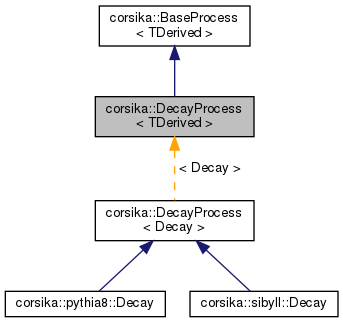
Process decribing the decay of particles. More...
#include <DecayProcess.hpp>
Public Member Functions | |
| template<typename TParticle > | |
| InverseTimeType | getInverseLifetime (TParticle const &particle) |
Additional Inherited Members | |
 Public Types inherited from corsika::BaseProcess< TDerived > Public Types inherited from corsika::BaseProcess< TDerived > | |
| using | process_type = TDerived |
| Base processor type for use in other template classes. | |
| Static Public Attributes inherited from corsika::BaseProcess< TDerived > | |
| static bool const | is_process_sequence = false |
| static bool const | is_switch_process_sequence = false |
| Protected Member Functions inherited from corsika::BaseProcess< TDerived > | |
| TDerived & | getRef () |
| const TDerived & | getRef () const |
| Protected Attributes inherited from corsika::BaseProcess< TDerived > | |
| friend | TDerived |
Detailed Description
template<typename TDerived>
struct corsika::DecayProcess< TDerived >
Process decribing the decay of particles.
Create a new DecayProcess, e.g. for XYModel, via
and provide the two necessary interface methods
Where, of course, SecondaryView and Particle are the valid classes to access particles on the Stack. In user code those two methods do not need to be templated, they could use the types e.g. corsika::setup::Stack::particle_type – but by the cost of loosing all flexibility otherwise provided.
SecondaryView allows to retrieve the properties of the projectile particles, AND to store new particles (secondaries) which then subsequently can be processes by SecondariesProcess. This is how the output of decays can be studied right away.
Definition at line 51 of file DecayProcess.hpp.
The documentation for this struct was generated from the following file:
- corsika/framework/process/DecayProcess.hpp