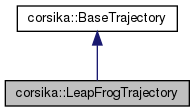
The LeapFrogTrajectory stores information on one leap-frog step. More...
#include <LeapFrogTrajectory.hpp>
Public Member Functions | |
| LeapFrogTrajectory (LeapFrogTrajectory const &)=default | |
| LeapFrogTrajectory (LeapFrogTrajectory &&)=default | |
| LeapFrogTrajectory & | operator= (LeapFrogTrajectory const &)=delete |
| LeapFrogTrajectory (Point const &pos, VelocityVector const &initialVelocity, MagneticFieldVector const &Bfield, decltype(1/(tesla *second)) const k, TimeType const timeStep) | |
| Line | getLine () const |
| Point | getPosition (double const u) const |
| VelocityVector | getVelocity (double const u) const |
| DirectionVector | getDirection (double const u) const |
| TimeType | getDuration (double const u=1) const |
| ! duration along potentially bend trajectory | |
| template<typename Particle > | |
| TimeType | getTime (Particle const &particle, double const u) const |
| ! time at the start (u=0) or at the end (u=1) of the track of a particle | |
| LengthType | getLength (double const u=1) const |
| ! total length along potentially bend trajectory | |
| void | setLength (LengthType const limit) |
| ! set new duration along potentially bend trajectory. | |
| void | setDuration (TimeType const limit) |
| ! set new duration along potentially bend trajectory. | |
Detailed Description
The LeapFrogTrajectory stores information on one leap-frog step.
The leap-frog algorithm uses two half-steps and is used in magnetic field tracking. The LeapFrogTrajectory will solve the leap-frog algorithm equation for a given constant \(k\) that has to be specified during construction (essentially fixing the magnetic field). Thus, different steps (length) can be dynamically generated here. The velocity vector will correctly point into the direction as calculated by the algorithm for any steplength, or intermediate position.
One complete leap-frog step is
\begin{eqnarray*} \vec{x}(t_{i+0.5}) &=& \vec{x}(t_{i}) + \vec{v(t_{i})} * \Delta t / 2 \\ \vec{v}(t_{i+1}) &=& \vec{v}(t_{i}) + \vec{v}(t_{i})\times\vec{B}(x_{i}, t_{i}) * \Delta t \\ \vec{x}(t_{i+1}) &=& \vec{x}(t_{i+0.5}) + \vec{v}(t_{i+1}) * \Delta t /2 \\ \end{eqnarray*}
The volocity update has the characteristics \(|\vec{v}(t_{i+1})|>1\), thus final velocities are renormalised. The full leap-frog steplength is thus
\[ L = |\vec{v}(t_{i+1})| \cdot \Delta t / 2 + |\vec{v}(t_{i+1})| \cdot \Delta t / 2 \]
Definition at line 45 of file LeapFrogTrajectory.hpp.
The documentation for this class was generated from the following file:
- corsika/framework/geometry/LeapFrogTrajectory.hpp