flat exponential density distribution with
\[ \varrho(\vec{r}) = \varrho_0 \exp\left( \frac{1}{\lambda} (\vec{r} - \vec{p}) \cdot \vec{a} \right). \]
\( \vec{a} \) denotes the axis and should be normalized to avoid degeneracy with the scale parameter \( \lambda \), \( \vec{r} \) is the location of the evaluation, \( \vec{p} \) is the anchor point at which \( \varrho_0 \) is given. More...
#include <FlatExponential.hpp>
Public Member Functions | |
| FlatExponential (Point const &point, Vector< dimensionless_d > const &axis, MassDensityType const rho, LengthType const lambda, NuclearComposition const &nuclComp) | |
| MassDensityType | getMassDensity (Point const &point) const override |
| NuclearComposition const & | getNuclearComposition () const override |
| GrammageType | getIntegratedGrammage (BaseTrajectory const &line) const override |
| LengthType | getArclengthFromGrammage (BaseTrajectory const &line, GrammageType const grammage) const override |
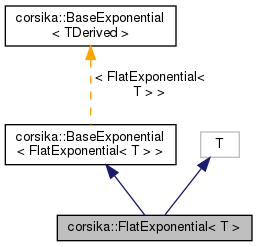
 Public Member Functions inherited from corsika::BaseExponential< FlatExponential< T > > Public Member Functions inherited from corsika::BaseExponential< FlatExponential< T > > | |
| BaseExponential (Point const &point, LengthType const referenceHeight, MassDensityType const rho0, LengthType const lambda) | |
| Point const & | getAnchorPoint () const |
Additional Inherited Members | |
| Protected Member Functions inherited from corsika::BaseExponential< FlatExponential< T > > | |
| auto const & | getImplementation () const |
| MassDensityType | getMassDensity (LengthType const height) const |
| Returns the mass density at altitude "height". More... | |
| GrammageType | getIntegratedGrammage (BaseTrajectory const &line, DirectionVector const &axis) const |
| For a (normalized) axis \( \vec{a} \), the grammage along a non-orthogonal line with (normalized) direction \( \vec{u} \) is given by: \[ X = \frac{\varrho_0 \lambda}{\vec{u} \cdot \vec{a}} \left( \exp\left( \vec{u} \cdot \vec{a} \frac{l}{\lambda} \right) - 1 \right) \quad \text{,} \] where \( \varrho_0 \) is the density at the starting point. More... | |
| LengthType | getArclengthFromGrammage (BaseTrajectory const &line, GrammageType const grammage, DirectionVector const &axis) const |
| For a (normalized) axis \( \vec{a} \), the length of a non-orthogonal line with (normalized) direction \( \vec{u} \) corresponding to grammage \( X \) is given by: \[ l = \begin{cases} \frac{\lambda}{\vec{u} \cdot \vec{a}} \log\left(Y \right), & \text{if} & Y := 1 + \vec{u} \cdot \vec{a} \frac{X}{\rho_0 \lambda} > 0 \\ \infty & \text{else} & \text{,} \end{cases} \] where \( \varrho_0 \) is the density at the starting point. More... | |
Detailed Description
template<typename T>
class corsika::FlatExponential< T >
flat exponential density distribution with
\[ \varrho(\vec{r}) = \varrho_0 \exp\left( \frac{1}{\lambda} (\vec{r} - \vec{p}) \cdot \vec{a} \right). \]
\( \vec{a} \) denotes the axis and should be normalized to avoid degeneracy with the scale parameter \( \lambda \), \( \vec{r} \) is the location of the evaluation, \( \vec{p} \) is the anchor point at which \( \varrho_0 \) is given.
Thus, the unit vector \( \vec{a} \) specifies the direction of decreasing height/altitude.
Definition at line 35 of file FlatExponential.hpp.
The documentation for this class was generated from the following file:
- corsika/media/FlatExponential.hpp